
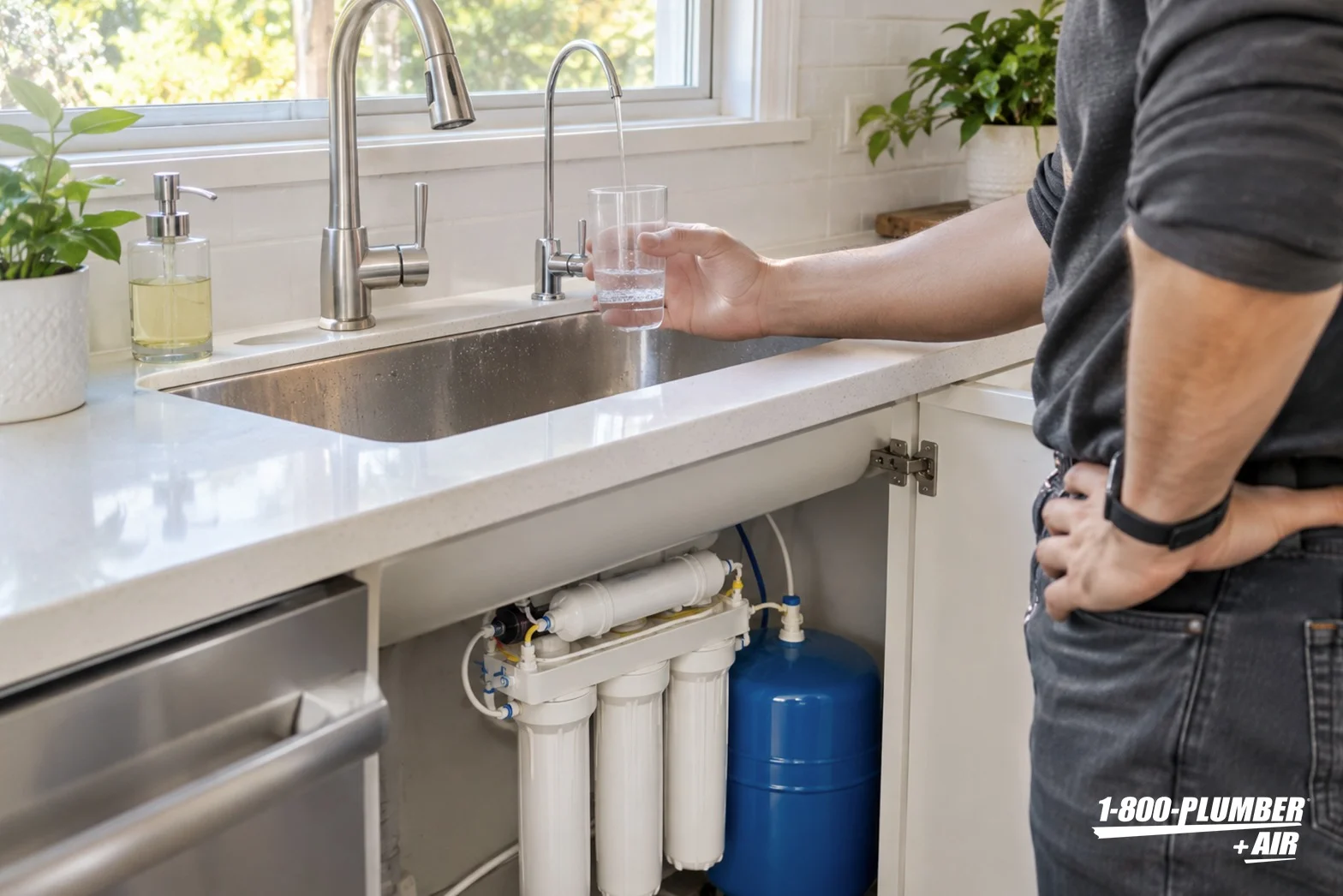
A reverse osmosis system that flows slowly usually has clogged filters, low tank air pressure, or low household water pressure. Change the filters first, then check the tank pressure with the tank empty. If it’s still weak, the membrane may be worn out.
A reverse osmosis system always runs slower than your regular faucet, so a short wait is normal. When one glass starts to feel like forever, though, something is holding the water back. Here’s what usually causes it and how to fix each one.
How Slow Is Too Slow for an RO Faucet?
RO water squeezes through a very fine membrane, so the stream is thinner than tap water. GE Appliances says a healthy RO faucet should fill a quart in about 40 seconds or faster.
Try the quart-jar test: open the RO faucet all the way and time how long a quart takes. If it’s much slower than 40 seconds, work through the causes below.
What Makes a Reverse Osmosis System Flow Slowly?
Six common causes fall into three groups: the filters, the pressure, and a few quick checks.
| What you notice | Likely cause | Try this first |
|---|---|---|
| Slower over months | Clogged filters | New pre-filters |
| New filters, still slow | Worn membrane | New membrane |
| A burst, then a trickle | Low tank pressure | Recharge the tank |
| Every tap is weak | Low house pressure | Test your pressure |
| Slow after heavy use | Empty tank | Wait a few hours |
| Slow after a filter change | Kink or closed valve | Check tubes and valves |
Filter Problems
Clogged filters are the most common cause. Pre-filters catch sand, rust, and chlorine until they fill up and flow drops. The membrane behind them wears out more slowly, as minerals gradually build up on its surface.
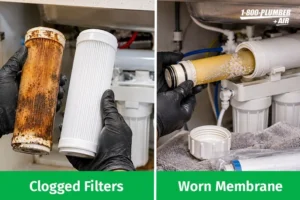
How to fix it: Shut off the feed valve and swap the pre-filters first. RO maker WaterAnywhere suggests changing pre-filters every 3 to 6 months and the membrane about once a year. If new filters don’t help, replace the membrane with the size your system takes.
Pressure Problems
A reverse osmosis system needs pressure in two places. An air bladder in the storage tank pushes water to the faucet, and your house pressure pushes water through the membrane.
A quick burst followed by a trickle usually points to the tank—a weak stream at every tap points to the house.
Fix the tank: Empty it, then check its air valve with a tire gauge. WaterAnywhere says it should read about 7 to 8 psi, so top it up with a bike pump but stay under 8. If it won’t hold air, the bladder is torn.
Fix the house pressure: Put a gauge on an outdoor hose bib. GE and WaterAnywhere both say home units need at least 40 psi. A failing water pressure regulator can drag every tap down, and a booster pump is the usual fix for low supply.
Quick Checks
Sometimes nothing’s broken at all. GE notes its RO systems take about 4 hours to make 2 gallons, so filling a big pot can simply drain the tank.
Other times a tube got pinched behind the trash can, or the feed valve was left half open after a filter change.
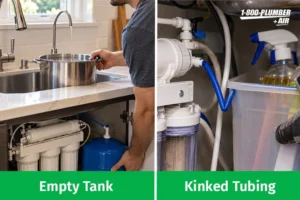
How to fix it: Wait a few hours and test again. Then trace the tubes, straighten sharp bends, and make sure the feed and tank valves are fully open.
When Should You Call a Plumber?
Call a pro if:
- The tank leaks or won’t hold air
- Your house pressure is under 40 psi
- Water leaks under the sink
- You’ve changed the filters and the flow is still slow
Our kitchen plumbing service can also replace a stuck shutoff valve under the sink.
If new filters and a recharged tank don’t fix the flow, the problem is usually pressure or plumbing, and that’s a job for a pro.
Why Call 1-800-Plumber +Air About Your RO System
Our local plumbers install and service reverse osmosis and water treatment systems every day. We’ll check the pressure, tank, and lines, then tell you honestly whether you need one part or a new reverse osmosis system.
Find your nearest 1-800-Plumber +Air office or call 1-800-758-6237.
Final Thought
A slow reverse osmosis system is usually an easy fix. Check the filters first, then the tank pressure, then your house pressure, and the membrane.
Want it done right the first time? Call 1-800-Plumber +Air at 1-800-758-623,7 and we’ll get your reverse osmosis system flowing again.
FAQ’s
Why is my reverse osmosis water so slow?
Clogged filters are the most common reason. Low air pressure in the storage tank and low household water pressure are the next two things to check.
How long does an RO tank take to refill?
A few hours. GE says its systems take about 4 hours to make 2 gallons, so heavy use can leave the tank empty for a while.
How often should I change RO filters?
WaterAnywhere suggests the pre-filters every 3 to 6 months and the membrane about once a year. Hard or dirty water can wear them out sooner, so check your manual.
Can low water pressure slow down a reverse osmosis system?
Yes. Most home RO units need at least 40 psi. Below that, your reverse osmosis system makes water slowly, and a booster pump usually fixes it