
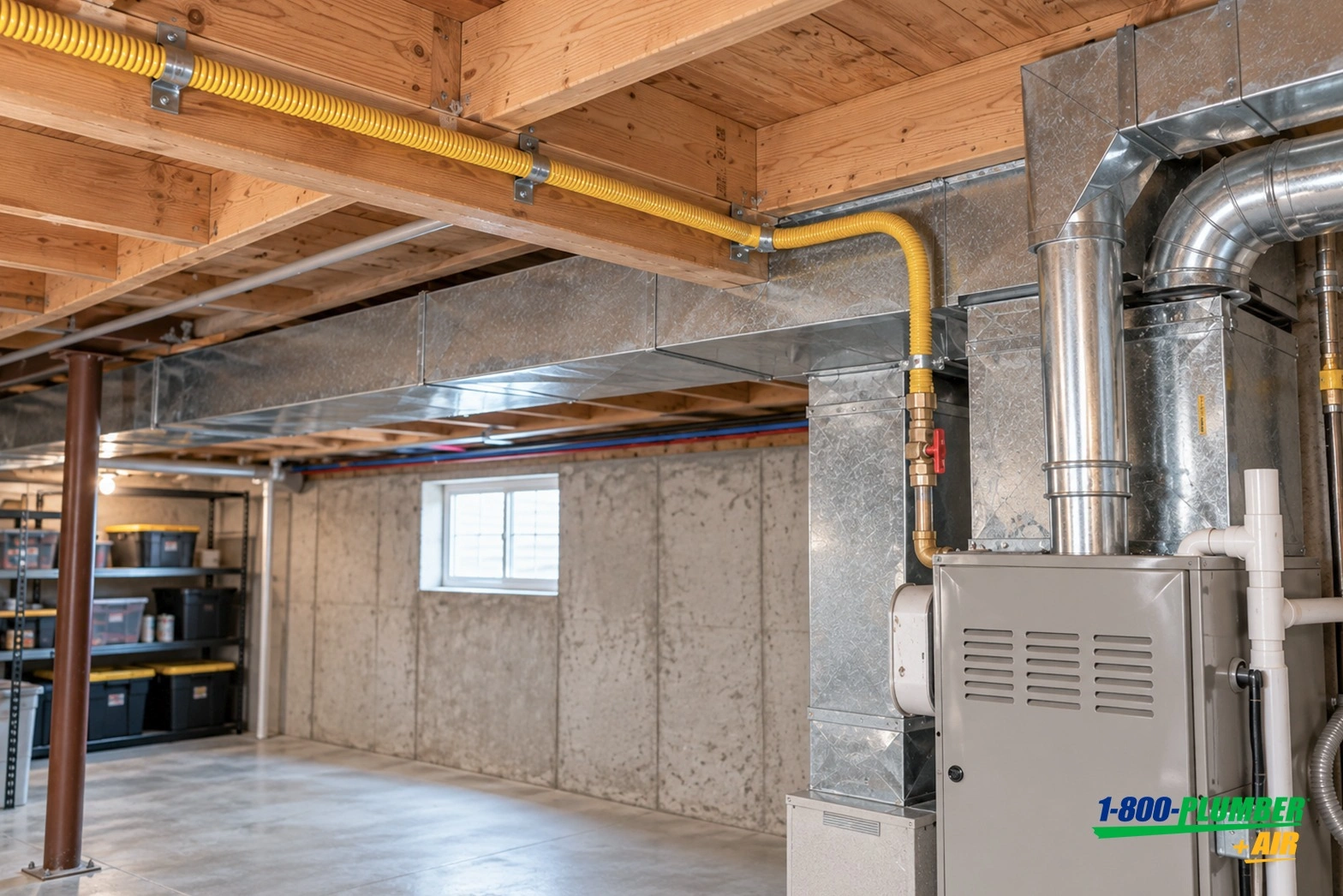
A CSST gas line is a flexible stainless steel tube, often covered with a yellow plastic jacket, that delivers natural gas or propane to your appliances. If your home inspector pointed it out, it’s probably because the bonding is missing.
TL;DR: CSST is a common, code-approved gas pipe found in many homes built or remodeled since the 1990s. Its thin walls can be punctured by electrical arcing after a nearby lightning strike, so the fuel gas code requires bonding to your home’s grounding system with at least 6 AWG copper wire. If you can’t find that wire and clamp, have a licensed plumber check it.
What is a CSST gas line?
CSST stands for corrugated stainless steel tubing. It’s a ribbed, bendable steel tube with a plastic jacket, sold on long rolls. It showed up in U.S. homes in 1990, right after a national product standard for it was adopted.
Most of it is yellow. Some newer brands use a black jacket built to hold up better against arcing. You’ll usually spot it in a basement or attic, running out to the furnace, water heater, range, or dryer.
How is CSST different from black iron pipe?
Black iron pipe is a strong, threaded steel pipe used for many years. Both types are code-approved, but each has its own pros and cons.
Where CSST wins
- Faster installs, since one continuous run can snake through framing.
- Fewer joints, which means fewer spots where a leak can start.
Where black iron wins
- Much thicker walls, so it’s tougher against arcing and physical damage.
- No special bonding step beyond normal code requirements.
Short version: CSST is quicker and cleaner to install, black iron is tougher, and neither is a problem when it’s installed and bonded right.
Why does lightning make CSST bonding matter?
Lightning doesn’t have to hit your roof. A strike on or near the house can send a surge through wiring that jumps, or arcs, onto the gas tubing. On thin-walled CSST, that arc can burn a pinhole, letting gas leak and possibly ignite.
Bonding is the solution. A thick copper wire connects the gas piping to your electrical grounding system. This helps balance voltage and lowers the chance of a spark. According to NFPA 54, the National Fuel Gas Code, CSST systems must use a bonding wire that is at least 6 AWG copper.
Pennsylvania’s fire commissioner has said direct bonding lowers the odds of an arc. Lowers, not erases.
Here’s the catch for older homes. Bonding rules were added to the national fuel gas code in 2009, so tubing installed before then may never have been bonded. That’s why it often lands on inspection reports.
Bottom line: an unbonded CSST gas line is what worries inspectors, not the yellow tubing itself.
How can you tell if your CSST is bonded?
You can take a quick look yourself. Just don’t tug on anything.
- Find where gas enters the house, near the meter.
- Follow the pipe inside to the rigid metal pipe or manifold just before the yellow tubing starts.
- Look for a metal clamp on that rigid pipe or fitting with a thick copper wire attached.
- Trace the wire. It should head toward your electrical panel or a ground rod.
Here’s what fools people in practice. A thin ground wire from an appliance circuit isn’t enough for CSST on its own. And a clamp on the plastic jacket doesn’t count; it has to grip bare metal pipe or a fitting.
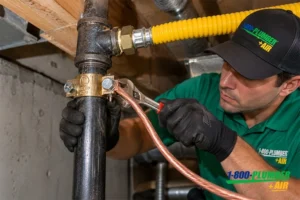
What does a plumber check during a CSST inspection?
A CSST gas line inspection goes past “is there a wire.” A licensed plumber typically checks:
- Bonding clamp: a listed clamp with metal-to-metal contact, in a spot you can reach.
- Wire size and route: 6 AWG copper or larger, running continuously to the grounding system.
- Tubing condition: kinks, crushed spots, nail damage, or missing protective plates in framing.
- Leaks: check at fittings and appliance connections.
Depending on where you live, a plumber or an electrician may make the final hookup at your panel. A good local pro will know which.
Found damage? Your plumber might swap out a section, or suggest a whole-home repipe if your other pipes are aging too. Want a pro checking in regularly? Check out our Home Guard Membership.
Final thought: Is your CSST gas line safe?
Most of the time, yes, as long as it’s bonded and in good shape. The tubing isn’t the enemy. Skipped bonding is.
If you found yellow tubing and no copper bonding wire, don’t wait for the next storm season. Book a gas line inspection with 1-800-Plumber +Air and find out if your system is bonded, damaged, or good to go.
FAQ
Is yellow flexible gas line safe?
Yes, as long as it is installed in accordance with the code and is properly bonded. Bonding helps prevent the main risk: arcing from lightning.
Does a CSST gas line need to be bonded?
Yes. The National Fuel Gas Code requires bonding CSST to the home’s grounding system with at least 6 AWG copper wire.
Who installs CSST bonding, a plumber or an electrician?
It depends on local rules. In some areas, a plumber handles it; in others, an electrician makes the connection at the panel, so ask before work starts.
Is black CSST better than yellow?
Black-jacketed CSST resists arcing damage better. Still, follow the manufacturer’s instructions and local code, which may require bonding either way.