
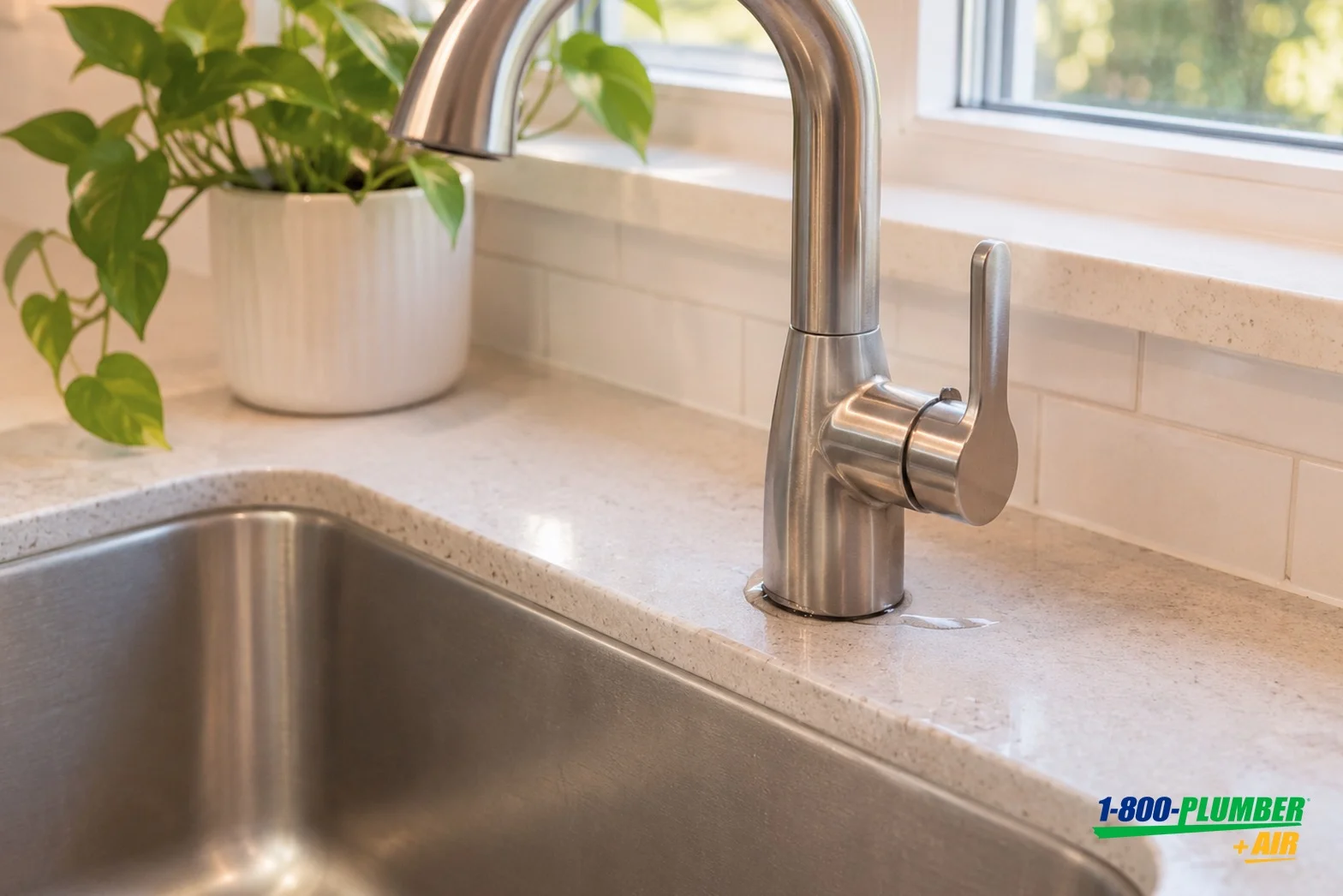
If your kitchen faucet is leaking at the base, it’s usually because of a loose mounting nut, a worn O-ring, or a cracked base gasket. This doesn’t mean you need to replace the whole faucet. Try tightening the mounting nut under the sink first—this often solves the problem. If it still leaks, the O-ring or cartridge inside the faucet is probably worn out.
See water collecting around the bottom of your kitchen faucet? That usually doesn’t mean the faucet is broken. It means one small part underneath it has simply worn out.
Grab a flashlight and try these five checks in order, from simplest to least likely—no plumbing experience needed.
Check these 5 spots, in order
Go through these one at a time. After each one, run the water and see if it’s still dripping before moving to the next.
Check 1: The mounting nut.
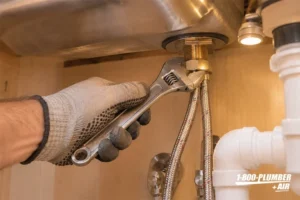
This is the nut under the sink that holds your faucet in place. If it’s loose, water can sneak through the gap and leak around the base. Reach underneath, find the nut right below the faucet, and turn it clockwise with a wrench until it’s snug.
Check 2: The supply line connection.
Two thin hoses run from the wall up to your faucet, one for hot water and one for cold. Sometimes they drip where they connect, and the water runs down and pools under the faucet, making it look like the faucet itself is leaking. Turn the water on and look closely at both connection points.
Check 3: The O-ring
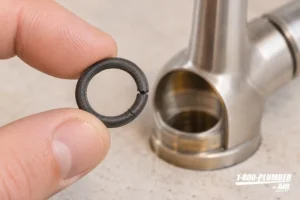
This is a small rubber ring that seals the spot where the faucet sits on the sink. Rubber dries out and cracks over time, and a cracked O-ring is one of the most common reasons water shows up at the base.
Check 4: The cartridge.
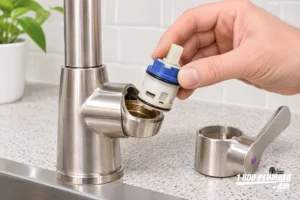
This is the part inside the faucet that controls the water flow when you turn the handle. When it wears out, water can leak down inside the faucet instead of coming out the spout, and you’ll notice a slow drip even with the handle all the way off.
Check 5: A crack in the faucet itself.
This one’s rare. If you’ve gone through every check above and it’s still dripping, a small crack in the faucet’s housing is usually what’s left, and no amount of tightening will fix that.
Checks 1 and 2 are the quickest to try and fix the problem most of the time, so start there.
When a check turns into a repair
If you’ve gone through checks 1 and 2 and water is still showing up, the problem is inside the faucet, not underneath it. At that point, a new O-ring or cartridge is usually the fix, and it helps to have someone experienced open up the faucet and look, rather than guessing which part is worn.
- Water keeps coming back even after the mounting nut is tight and the hose connections are dry.
- You see water at the base even when the faucet is completely turned off
- There’s a visible crack in the faucet itself
Our kitchen plumbing team can open up the faucet, check the O-ring and cartridge, and tell you whether it needs one part replaced or a full faucet swap. If you’re also finding water somewhere else in the house, not just at the faucet, our water leak team can track that down too.
One more thing worth ruling out: if the drip is coming from the shutoff valve under the sink,d not the faucet, that’s a different fix. See our guide on a leaking shut-off valve.
Still dripping after the checks? Call 1-800-Plumber +Air
If you’ve worked through all five checks and water is still showing up, or you’d rather have someone else handle the parts under the sink, 1-800-Plumber +Air can take it from there. Call 1-800-PLUMBER (1-800-758-6237), and we’ll get it sorted.
FAQ’s
Why is water only coming out of the base of my faucet?
Usually it’s a loose mounting nut (the nut that holds the faucet down) or a worn O-ring (a small rubber seal), not the spout or handle.
Can I fix this myself without calling a plumber?
Often yes, especially if it’s the mounting nut or the supply line connections. You can also try the O-ring or cartridge, but it depends on how your faucet comes apart.
Does this mean I need a whole new faucet?
Not usually. Most of the time it’s one worn part, and replacing just that part solves it.
My faucet has weak water pressure instead of a leak. Is that the same problem?
Usually not. Low pressure at one sink is typically a clogged aerator, not a worn base seal. See our guide on fixing low water pressure in one sink.
What if it’s an outdoor faucet, not the one in my kitchen?
That’s a different fix, especially heading into cold weather. See our guide on protecting outside faucets from freezing.