TL;DR. Most commercial plumbing problems that close a business start small, like a slow floor drain or a water heater that can’t keep up. The five that cause the most shutdowns are grease clogs, sewer backups, heater failure, hidden leaks, and backflow issues. Catching one early is the difference between a service call and a lost day of revenue.
Commercial plumbing problems always seem to show up at the worst times. You might be in the middle of a busy Friday dinner rush or a crowded Saturday morning at the salon when something goes wrong. Maybe a restroom is out of order, or a kitchen drain is clogged, and suddenly you have to figure out if you can keep your doors open. Here’s what usually causes these problems, what you should do right away, and when you need to call a licensed commercial plumber.
Why a Plumbing Failure Can Close Your Doors in Minutes
For many businesses, staying open is required by code, not just for convenience. Food service operations have to stop serving if there is an imminent health hazard. The FDA Food Code lists sewage backup and long-term loss of water service as examples (FDA Food Code, 8-404.11). Without running water, staff cannot wash their hands, so it is not legal to keep serving.
Other businesses feel it just as fast. A salon without working restrooms sends clients home. A retail floor with water spreading across it has a slip hazard and an insurance claim.
The cost is rarely the repair. It’s the hours you couldn’t trade.
5 Commercial Plumbing Problems That Cause Most Shutdowns
1. Grease Clogs
When grease goes down the drain, it starts warm but soon cools and sticks to the inside of the pipe. As more grease builds up, less room is left for water to pass through. The EPA reports that grease from restaurants, homes, and industrial sources causes 47% of sewer blockages (EPA, National Pretreatment Program). If your prep sink drains slowly after service, that can be an early warning sign.
2. Sewer Backups
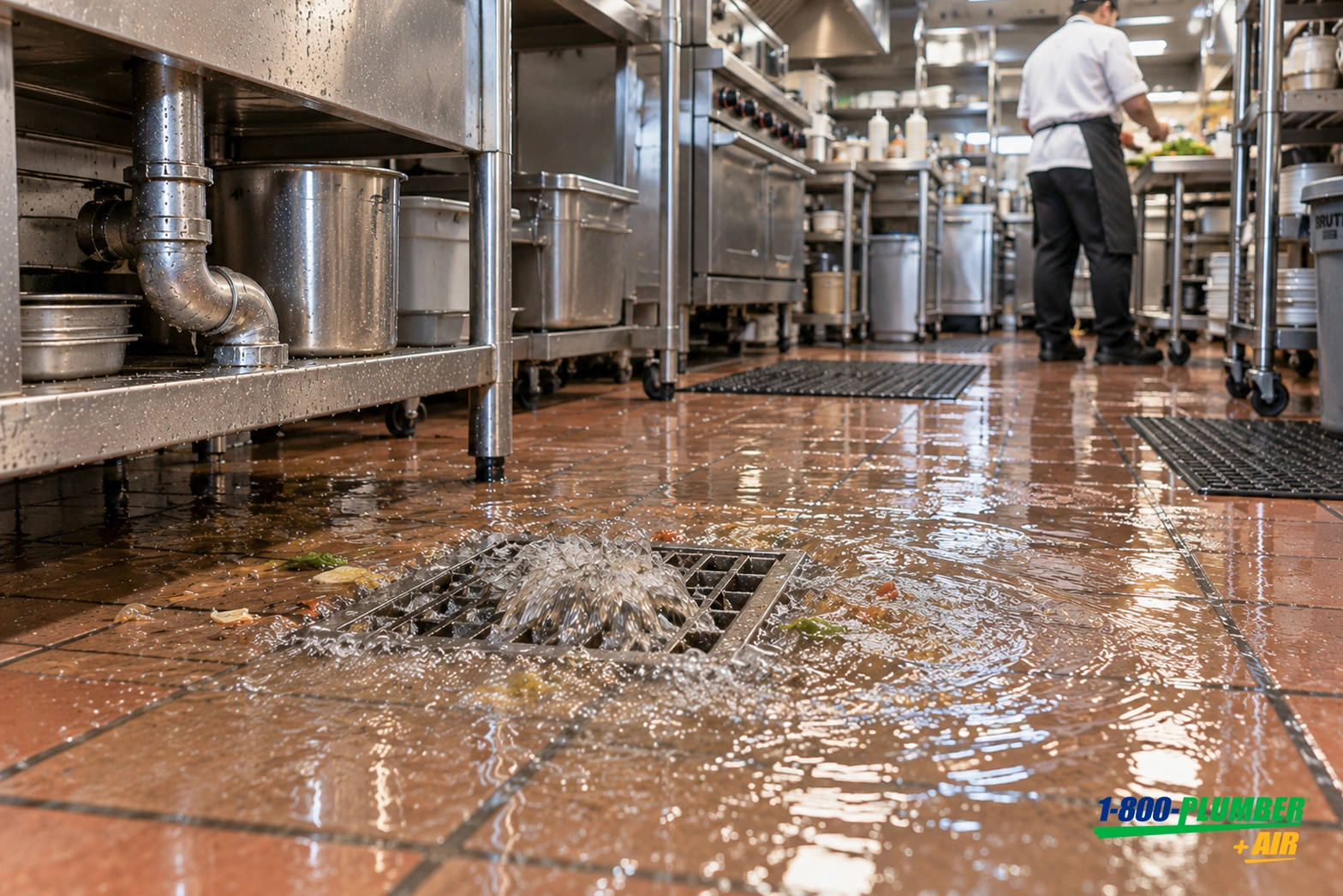
However, if the main sewage pipe gets clogged, no water can flow out of the system. Water accumulates at the lowest point, usually a floor drain or mop sink. These events may occur because of roots growing into the piping, wipes, mineral buildup, or damaged pipes. The department addresses the problem the same day because sewage on the floor is a health threat.
3. Heater Failure
No hot water could affect the dishwashing station, salon, and related services. Several factors could cause this problem. These include burner buildup, heating-element issues, or an undersized water heater.
4. Hidden Leaks
Water leaks near the suspended ceiling are hard to spot because the problem only becomes evident when stains appear on the ceiling. Sometimes, the supply line bursts at night, and the water gathers in the morning. You can spot a leak by a sudden rise in water bills, increased floor temperature, and low water pressure.
5. Backflow Failures
If a backflow preventer fails, it can allow contaminants to flow backward into the drinking water system. In many places, you must test commercial equipment. If you don’t do the tests, they can cut off the water supply.
What’s Actually Causing These Failures?
Most commercial plumbing problems don’t start with bad artistry. They build slowly, for reasons we run into week after week:
- Volume. A busy restaurant puts more through its drain lines in a day than a home does in a month.
- Pipe age. Older buildings often still run cast iron or galvanized steel, and both corrode from the inside where nobody can see it.
- Split responsibility. In a leased space, the tenant assumes the landlord handles it, and the landlord assumes the tenant does, so nothing gets scheduled.
What You Can Safely Do in the First 10 Minutes
- Shut off the water. Isolate the fixture, or the building main if water is spreading. Every manager should know where that valve is.
- Stop using everything on that line. Adding more water to a blocked drain makes the backup worse.
- Protect the site from any unauthorized personnel: Post wet-floor warnings and limit access to wet areas for employees and visitors.
- Treat sewage as a pollutant. Wear gloves and closed-toe shoes, and keep them separate.
- Document it. Take photos and note the time it started. Your plumber can diagnose it faster, and your insurer will ask.
What to Avoid
- Chemical drain cleaner is not very effective at clearing a grease-clogged sewer line, and using it can make the pipe dangerous for people working on it afterward.
- Renting a drain machine for the main line. Without knowing the pipe material, you can easily crack an older pipe or lose the cable.
- Repeatedly resetting a water heater that keeps failing, especially a gas unit.
- Living with a slow drain. If it clears and then slows again, it isn’t fixed. It’s a blockage rebuilding.
When to Call a Commercial Plumber Right Away
- Sewage at a floor drain, mop sink, or any fixture
- More than one fixture backing up at once, which points to the main line
- No water or no hot water in a food service, childcare, or medical setting
- A gas smell near a water heater. Get everyone out and call your gas utility first.
- Water appearing where you can’t trace the source
Final Thought
Most commercial plumbing problems have warning signs before total failure occurs. This can be illustrated by cases like reduced water flow through a drain, water heaters that don’t perform satisfactorily, and smells returning after cleaning; all of these qualify as emergencies when they should be scheduled maintenance. Map shutoff valves and plan drain and grease trap service instead of treating them as emergencies. If you have a backup and sewage smells, we encourage you to call an expert. At 1-800-Plumber +Air, we offer 24/7 Commercial Plumbing Services.
FAQs
What is the most common commercial plumbing problem?
Drain clogging is the most common problem, and in buildings with a kitchen, grease is often the main cause. According to the United States Environmental Protection Agency (USEPA), grease causes 47% of reported sewer blockages.
Can a business be forced to close because of a plumbing problem?
Yes. Under the FDA Food Code, a food establishment must stop operating when an imminent health hazard exists, and a sewage backup or extended loss of water service both qualify. Other businesses aren’t always required to close, but losing restrooms usually forces the same decision.
How often should commercial drains be cleaned?
Service frequency depends on production volume. Kitchens that produce a large amount need service several times a year, while smaller office or commercial establishments can be serviced less often. However, past performance is a better indicator; if there was ever a problem before, schedule services in advance.
How do I know if the clog is in my line or the city sewer?
If one fixture is slow, the problem is usually local. If several back up at once, or the lowest drain overflows when you run water elsewhere, the problem is the main line or beyond. If neighboring businesses have the same trouble, call your water authority too.