

A water softener removes the calcium and magnesium that make water hard and cause scale. A whole-house filter removes contaminants such as chlorine, sediment, and bad taste or odor. If your water is both hard and unpleasant, you need both systems, plumbed in the right order.
What a Water Softener Does
A softener passes water through a tank of resin beads, exchanging calcium and magnesium ions for sodium ions. That process is called ion exchange, and it is the technology behind the softeners installed through the water treatment and filtration services offered by 1800 Plumber. It pulls those minerals out, and scale stops forming inside pipes, water heaters, and dishwashers.
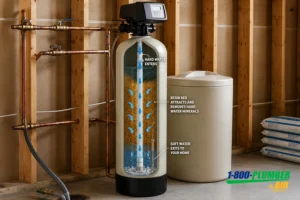
What a softener won’t do is clean your water. Chlorine, sediment, pesticides, and most other contaminants pass straight through. Softened water is gentler on your plumbing and your skin. It isn’t filtered water.
What a Whole House Filter Does
A whole‑house filter is placed where the main line enters the home, ensuring that every tap downstream receives treated water. Most systems start with activated carbon, which removes chlorine, chlorine byproducts like trihalomethanes, VOCs, pesticides, and herbicides. Many also include a sediment pre-filter to catch grit and rust.
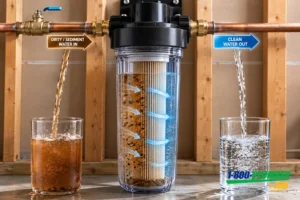
Here’s the catch. Carbon does nothing to dissolved calcium or magnesium. Those minerals sail straight through the media and keep spotting glassware.
A filter fixes taste, odor, and chemical content. A softener fixes hardness. Neither one covers for the other.
Water Softener vs Whole-House Filter: Which One Does Your Home Need?
Signs you need a softener
- Chalky white crust on faucets, shower heads, and kettle elements
- Cloudy glassware straight out of the dishwasher
- Soap and shampoo don’t lather up as they should.
- Laundry that comes out stiff or gray
- A water heater that pops, rumbles, or dies early
Signs you need a filter
- A chlorine or swimming-pool smell at the tap
- Metallic, musty, or earthy taste
- Visible sediment in an aerator screen
- Private well water, which nobody is treating but you
- A city water quality report listing something you’d rather not drink
Test before you buy either one
Don’t try to estimate this on your own. Based on the U.S. Geological Survey, water is considered hard at 121 mg/L of calcium carbonate and very hard if it’s above 180 mg/L. If you have city water, you can find this number for free in your utility’s annual Consumer Confidence Report. If you use well water, you’ll need to pay for a lab test. Plumbers measure softeners in grains per gallon, and one grain per gallon is about 17.1 mg/L.
What Does Each System Cost?
Angi’s 2026 cost data puts water softener installation at about $1,500 on average, with a range of $200 to $6,000 depending on capacity, home size, and the amount of plumbing required. Broader water treatment systems, including whole-house filtration, average $2,274, with most homeowners spending between $1,129 and $3,541.
Running costs split differently. Softeners need salt. Filters need media or cartridge changes on a schedule. Budget for both if both systems are running.
Do You Need Both?
Plenty of homes do. The water softener vs. whole-house filter choice isn’t always an either/or choice, because hard water and chlorine are separate problems that need separate fixes.
Many homeowners don’t realize that the order of water treatment equipment is important. Putting the carbon filter before the softener removes chlorine before it reaches the resin bed, which helps the resin last longer. But if your water is very hard, some installers may change the order to protect the filter media. The best approach is to have a plumber recommend the right setup for your home based on actual test results, rather than relying only on catalog suggestions.
Fair warning: two systems means two maintenance schedules.
Why Homeowners Turn to 1-800-Plumber +Air for Water Treatment
Sizing a softener or a filter correctly starts with knowing what is in the water, which is why 1-800-Plumber +Air begins water treatment jobs with an in-home water quality test rather than a sales pitch. The company installs all the options covered above: salt-based softeners, activated carbon filtration, whole-house systems, and reverse osmosis units for drinking water.
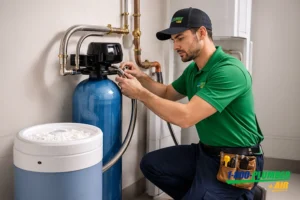
Licensed, insured technicians handle the plumbing side of the install, from cutting in a bypass loop to programming the control valve. With locations nationwide and 24/7 emergency availability, one team specifies, installs, and services the system.
Final Thought
If you are choosing between a water softener and a whole-house filter, begin by testing your water. A softener works best for hard water, while a filter is better if you find contaminants in your water. Make sure to test your water before making a purchase.
Not sure what is actually in the water? 1800 Plumber +Air offers in-home water quality testing and installs softeners, carbon filters, and reverse osmosis systems. Call 1-800-758-6237 or schedule service at your nearest location.
FAQ
Does a whole house water filter soften water?
No, normal filters remove particles and chemicals from water, but they cannot eliminate the minerals that make water hard. They remain in the water and continue to form scales. To treat hard water, a water softener or conditioner that modifies the behavior of these minerals is required.
Does a water softener remove chlorine or bacteria?
No, ion exchange only removes calcium and magnesium. It does not affect chlorine, chloramine, VOCs, sediment, or bacteria. Because softened water is not the same as purified water, many homes with city-treated water also use carbon filters in addition to a softener.
Which one should go first, the filter or the softener?
Usually, the carbon filter is installed first to keep chlorine away from the softener resin. This helps protect the resin and makes it last longer. In homes with very hard water, the order is sometimes switched to protect the filter media instead. It’s best to have a licensed plumber make the final decision after checking your water test results.
Is hard water bad for your health?
The EPA addresses problems caused by hard water through secondary standards that focus on taste, staining, and scale rather than health risks. Hard water is usually safe to drink, but it can harm appliances, fixtures, and water heaters.