
If your AC is functioning without any problems but isn’t cooling, there are three things to check first: your thermostat settings, whether your air filter is clogged, and whether the breaker on your outdoor unit is tripped. If all of these look good and the air still isn’t cold after 30 minutes, the problem might be low refrigerant, a faulty capacitor, or a frozen coil. For those issues, you’ll need to call a licensed HVAC technician.
Why does your AC blow air but the house stays warm?
Your system doesn’t make cold air. It pulls heat out of your home using refrigerant, an indoor evaporator coil, and an outdoor condenser coil. The blower keeps pushing air through your vents even when that heat transfer has quietly stopped. So you feel air. It just isn’t cool air.
Two categories break the process: restricted airflow or a refrigerant or electrical failure. Airflow is usually the one you can handle yourself. ENERGY STAR notes that airflow problems can reduce a system’s efficiency by up to 15 percent, and the U.S. Department of Energy says routinely replacing or cleaning air filters can lower an air conditioner’s energy consumption by 5 to 15 percent. That’s exactly why annual AC maintenance pays for itself.
What most people do not realize is how slowly it happens. The house does not suddenly get hotter because it was cold yesterday; it simply stops keeping up with the heat on a hot afternoon.
Airflow problems you can often fix in minutes. Refrigerant and electrical failures you can’t.
What to check yourself first
Take ten minutes to check these things before you call for help.
1. Thermostat settings
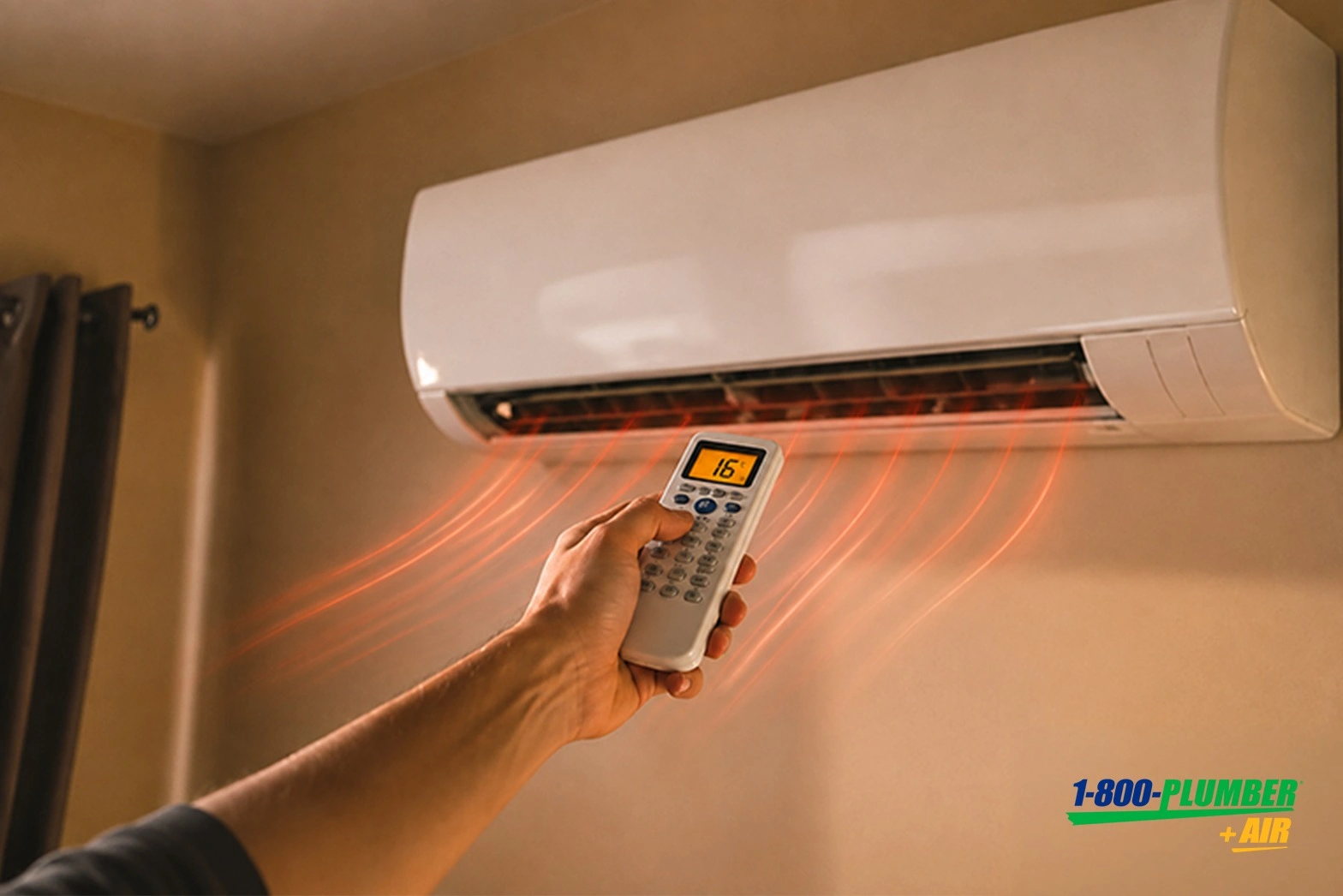
Set it to Cool, not Fan. Fan mode blows air without running the compressor, which produces exactly the symptom you’re describing. Drop the setpoint at least five degrees below room temperature. Swap the batteries while you’re there. If the screen is blank or the readings look wrong, that’s a thermostat problem, not a cooling problem.
2. Air filter
Take out the air filter and hold it up to a light. If you can’t see light through it, it’s time to replace it. A dirty, gray filter can block airflow to the point that it might freeze the indoor coil.
3. Breaker and outdoor unit
Your AC has two breakers: one for your indoor unit and another one for your outdoor unit. If only the outdoor breaker trips, your blower will run while the air remains warm. Go out and check whether the fan is rotating and that there are no grass cuttings on the coil.
4. Vents and returns
If supply vents are closed or furniture is blocking a return, your system won’t get enough air. Open all the vents and make sure returns are clear.
Signs it’s a real repair, not a quick fix
If you notice any of the following issues, stop troubleshooting and schedule an air conditioning repair.
- There is ice forming on the copper line or the indoor coil.
- The outdoor fan does not spin, or the unit just hums and does not work.
- You hear a hissing or bubbling sound near the lineset, which often indicates a refrigerant leak.
- The breaker trips again immediately after you reset it.
- Even with the correct settings and a clean filter, the air is still warm after 30 minutes.
It’s important to know that your system is sealed and does not use up refrigerant like a car uses oil. If a technician says the refrigerant is low, there is a leak. Simply adding more without fixing the leak will mean you have the same problem next season.
What AC repair actually costs
The cost of services varies by your geographic location and the problem, so the figures stated above are only estimates. Typically, AC repairs cost around $350, and most people spend between $150 and $650 on the same in 2026. The most common service is replacing a run capacitor, which may cost between $150 and $300. Fixing and recharging to repair a refrigerant leak will cost between $400 and $1,000, depending on the leak’s location. Replacing a compressor when it is out of warranty will cost between $1,200 and $2,800.
Climate changes the answer.
Your geographic location affects how quickly a small problem can escalate into an uncomfortable situation at home. In Amarillo and Dallas, dust combined with long summer periods places a strain on your filter and condenser coils. Meanwhile, in Richmond, Charlotte, and Clearwater, high humidity keeps your coils wet and can block the drain lines.
1-800-Plumber +Air runs licensed technicians out of local franchise locations across the country, so the person who shows up already knows what fails in your climate. And because we offer 24/7 emergency HVAC service, a Saturday breakdown doesn’t have to wait until Monday.
Local systems fail in local ways. A tech who works your climate every week diagnoses faster.
Final Thought
An AC running but not cooling is a symptom, not a diagnosis. Run the ten-minute checklist first, because a meaningful share of these calls turn out to be a filter, a setting, or a breaker. If you get through the list and the air is still warm, you’ve saved the technician time and yourself a repeat visit.
Still blowing warm air? Don’t wait it out in the heat. 1-800-Plumber +Air has licensed, insured HVAC technicians available 24/7, and you’ll get pricing before any work starts. Call 1-800-758-6237, find your nearest location, or ask about Home Guard Membership to keep your system maintained year-round.
FAQ
Why is my AC running but not cooling the house?
Usually, it’s a thermostat set to Fan, a clogged filter, a tripped outdoor breaker, low refrigerant, or a failed capacitor. You can check the first three in ten minutes.
Can a dirty air filter stop my AC from cooling?
Yes. Restricted airflow lets the evaporator coil freeze over, and cooling stops. Run fan-only until the ice melts, then install a clean filter.
How long should I wait before calling an HVAC technician?
Give it 30 minutes with correct settings and a clean filter. Still warm? Call. Running a struggling system for days can turn a small repair into a compressor failure.
Does low refrigerant mean I need a new AC?
Not usually. Sealed lines mean low charge equals a leak, which a tech repairs and recharges. Replacement makes more sense after 10 to 15 years or on R-22 systems.
Is it safe to run my AC if it’s not cooling?
Not for long. Frozen coils and failing parts strain the compressor, the most expensive component in the system.